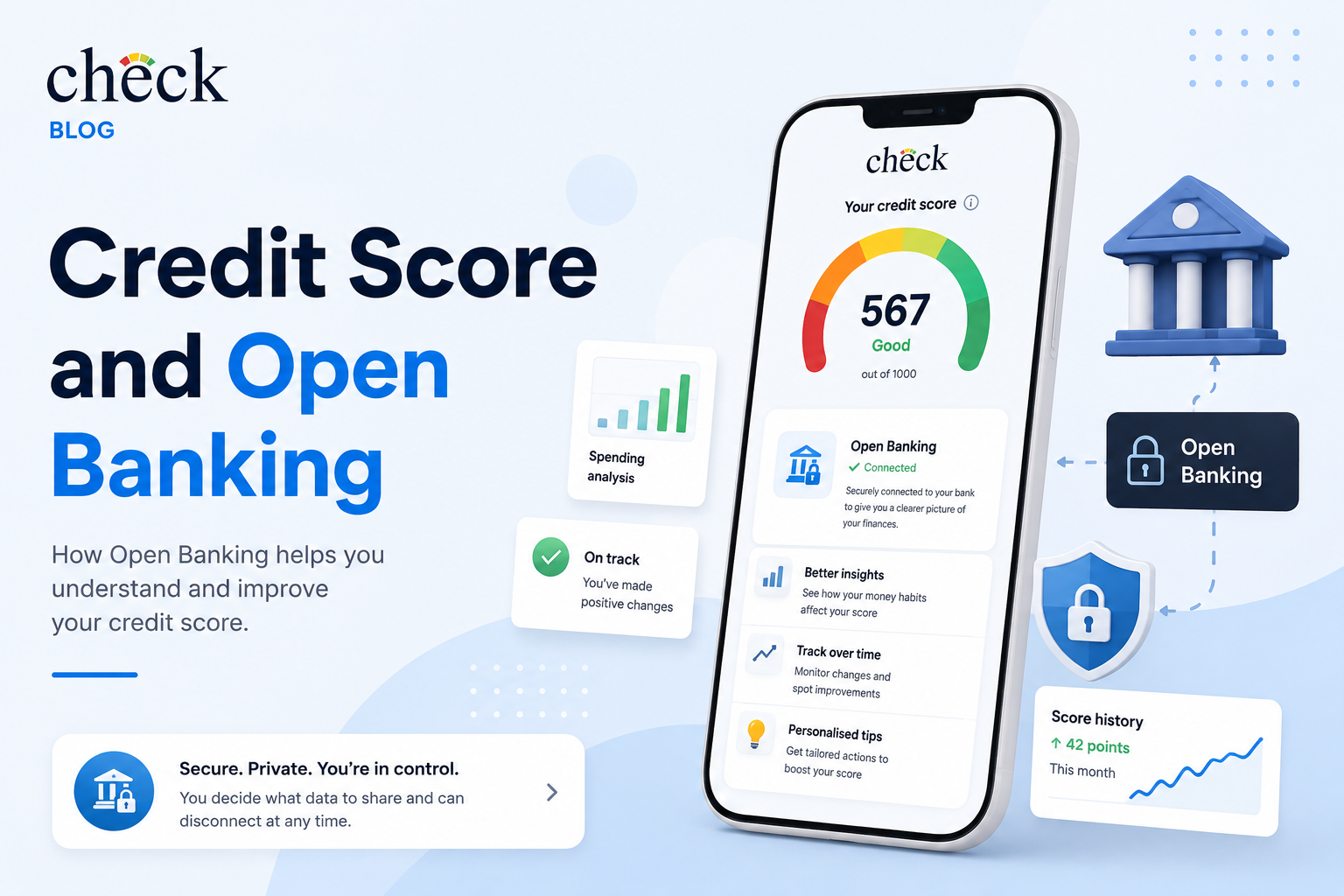
Open Banking has changed the way people can share their financial information with banks, lenders and other financial services providers.
But what does it actually mean for your credit score?
If you’ve ever been asked to connect your bank account when applying for a loan or other financial product, you may have wondered whether doing so will improve or damage your credit score.
The short answer is: Open Banking itself doesn’t automatically increase your credit score. However, the financial information you choose to share can give lenders a much clearer picture of your income, spending and affordability — and in some circumstances, it may help you access credit that you might otherwise struggle to obtain.
Here’s what you need to know.
What's Included?
What is Open Banking?
Open Banking allows you to securely share information from your bank account with an authorised third party, with your permission.
Instead of relying solely on information contained within your credit report, Open Banking can provide access to information such as:
- Your regular income
- Salary payments
- Regular household spending
- Existing financial commitments
- Account balances
- Regular payments
- Patterns in your financial behaviour
The FCA says Open Banking has already seen significant growth in the UK, with more than 16 million active users reported in 2025.
Importantly, you remain in control of whether you give permission for your information to be shared.
Does Open Banking affect your credit score?
Not necessarily.
Simply connecting your bank account through Open Banking doesn’t mean your credit score will automatically go up or down.
Your credit score is based on information held within your credit report and the scoring model being used. Different credit reference agencies and lenders can use different information and scoring systems.
That’s why your credit score isn’t necessarily the same thing as the score or assessment a lender uses when deciding whether to approve an application.
However, Open Banking can provide additional information that a lender may use when assessing your application.
This is where things get interesting.
Open Banking vs your credit report
Your credit report is largely a record of your borrowing history.
It can include information such as:
- Credit cards
- Loans
- Mortgages
- Car finance
- Repayment history
- Credit limits and balances
- Defaults
- County Court Judgments
- Credit applications and searches
Open Banking can provide a different perspective.
Rather than looking primarily at your previous borrowing, it can help a lender understand what your finances look like today.
For example, imagine two people have similar credit files.
Both have a relatively limited credit history and similar credit scores.
However:
Person A
- Has a regular salary
- Has manageable monthly commitments
- Regularly pays household bills
- Has money left over at the end of the month
Person B
- Has an inconsistent income
- Has significant regular commitments
- Frequently uses their overdraft
- Has very little disposable income
Their credit reports may look relatively similar, but their current financial circumstances could be very different.
Open Banking can help a lender see that difference.
Can Open Banking help if you have a low credit score?
Potentially.
This is one of the reasons Open Banking is becoming increasingly important in modern lending.
A low or limited credit score doesn’t necessarily mean that you cannot afford to repay a loan.
You might have a limited credit history because you:
- Have never borrowed much
- Have recently moved to the UK
- Are young and haven’t built much credit history
- Don’t have many credit accounts
- Have experienced previous financial difficulties
- Have a relatively “thin” credit file
Open Banking can potentially give lenders additional information about your current financial position.
This doesn’t guarantee acceptance, but it can give lenders more information when assessing affordability and risk.
Recent lending developments are increasingly combining traditional credit information with real-time financial data to create a broader picture of a customer’s circumstances.
Could Open Banking actually improve your credit score?
This depends on how the information is being used.
Open Banking data doesn’t automatically get added to your credit report simply because you’ve connected your account.
However, some services use Open Banking to identify positive financial behaviours.
For example, Experian’s Boost service allows eligible customers to connect certain financial accounts and can use additional payment information to potentially increase their Experian score.
So there is an important distinction:
Open Banking connection ≠ automatic credit score increase.
Instead, Open Banking may:
1. Provide additional information to lenders
or
2. Allow certain services to recognise positive financial behaviour
or
3. Help demonstrate affordability where your traditional credit history doesn’t tell the full story.
Will Open Banking hurt my credit score?
Generally, connecting your bank account through Open Banking isn’t the same as making a hard credit application.
However, you should always understand why your information is being requested and what it will be used for.
If you’re applying for credit, the lender may still carry out its own credit checks. Depending on the application and lender, this could involve a hard search, which can appear on your credit report.
Open Banking itself isn’t a substitute for understanding the credit application you’re making.
Why are lenders interested in Open Banking?
For lenders, one of the biggest benefits is better affordability information.
Traditional credit information can tell a lender a lot about your borrowing history, but it may not provide a complete picture of your current income and expenditure.
Open Banking can potentially help lenders assess:
Income
How much money comes into your account and how regularly.
Expenditure
What you’re spending money on each month.
Existing commitments
Your regular financial obligations.
Affordability
How much disposable income may remain after your regular commitments.
Financial behaviour
Patterns that may not be visible from a traditional credit report.
This can potentially support more informed and responsible lending decisions. Check.co.uk’s own Open Banking integration with Evlo, for example, uses real-time income and expenditure information alongside credit information to support affordability assessment.
Open Banking could be particularly useful for people with limited credit histories
One of the most interesting developments is the potential impact on financial inclusion.
Someone with a limited credit history may find that their credit report doesn’t tell the whole story.
For example, you could have:
- A relatively short credit history
- A low credit score
- Few existing credit accounts
but still have:
- A stable income
- Consistent financial commitments
- Good money management
- Enough disposable income to comfortably afford repayments
Open Banking can potentially help provide that additional context.
It doesn’t mean a lender has to approve an application, but it can give them more information on which to base their decision.
Is Open Banking safe?
Open Banking is designed to allow customers to share their financial information securely with authorised providers.
You should always check who you’re giving permission to and what information you’re agreeing to share.
You should also be cautious of anyone asking you to provide your online banking password or security credentials directly.
With legitimate Open Banking connections, you are normally redirected to your bank to authenticate the connection rather than handing your banking password to the third party.
For example, Experian explains that its Open Banking connection uses a secure process where customers log in through their bank rather than giving Experian their bank login details.
So, should you connect your bank account?
It depends on why you’re being asked to do it.
If you’re applying for finance and the lender uses Open Banking as part of its affordability assessment, sharing your information could potentially help provide a more complete picture of your financial circumstances.
If you’re using a service specifically designed to recognise positive financial behaviour, it could potentially help you demonstrate financial responsibility that isn’t fully visible on your traditional credit report.
But you should always understand:
- Who is accessing your information
- What information they’re accessing
- Why they need it
- How long they’ll retain it
- Whether you can withdraw permission
- Whether the service is authorised
The bigger picture: credit scores are only part of the story
One of the biggest misconceptions about borrowing is that your credit score is the only thing lenders look at.
It isn’t.
Lenders can have their own criteria for assessing applications, and creditworthiness can involve factors beyond the number you see on your credit report.
That’s why two people with similar credit scores can receive completely different lending decisions.
Open Banking is part of a wider shift towards using more comprehensive financial information when assessing customers.
Rather than simply asking:
“What has this person done with credit in the past?”
the industry is increasingly able to ask:
“What does this person’s financial position actually look like today?”
How to improve your credit position
Whether or not you use Open Banking, there are several practical steps you can take to improve your overall credit position:
1. Check your credit report regularly
Look for incorrect information, accounts you don’t recognise or missed payments that may have been recorded incorrectly.
2. Pay your bills on time
Your payment history is an important part of your credit profile.
3. Keep credit utilisation under control
If you have credit cards, try not to consistently use a very high percentage of your available credit.
4. Avoid making lots of applications in a short period
Multiple credit applications can result in multiple hard searches and may make it harder to demonstrate stable borrowing behaviour.
5. Keep your personal information up to date
Make sure your address and other details are accurate across your financial accounts.
6. Understand your affordability
A good credit score doesn’t necessarily mean you can comfortably afford additional borrowing. Look at your income, spending and existing commitments before applying for credit.
The future of credit assessment
Open Banking is unlikely to replace traditional credit reports overnight.
Instead, we’re likely to see the two work increasingly alongside each other.
Credit reports provide valuable information about your historical credit behaviour, while Open Banking can provide a more current picture of your income, spending and affordability.
The FCA’s developing vision for Open Finance goes even further, with the potential for consumers to securely share broader financial information to access more personalised and potentially more inclusive financial services.
For consumers, that could mean lending decisions increasingly look beyond a single credit score and consider a much broader picture of financial health.
The bottom line
Open Banking doesn’t automatically improve your credit score.
But it can give lenders and financial services providers a more detailed view of your financial circumstances, particularly your income, spending and affordability.
For people with limited or imperfect credit histories, that additional information could potentially help demonstrate that they are financially capable of managing credit.
Your credit score is important, but it’s only one part of the picture.
Understanding your credit report, managing your finances responsibly and knowing what lenders may look at can put you in a much stronger position when you’re ready to apply for credit.
Want to understand what’s affecting your credit score?
Check your credit information for free with Check.co.uk and see the factors that could be affecting your creditworthiness.